grdrotater

grdrotater(cmd0::String="", arg1=nothing; kwargs...)

Takes a geographical grid and reconstructs it given total reconstruction rotations.

See full GMT docs at grdrotater

Warning

This GMT supplements module has not yet received the proper attention to port the original manual.

Parameters

  • A | rot_region :: [Type => Str | Tuple | Vec]

    Specify directly the region of the rotated grid.

  • D | rot_outline :: [Type => Bool or Str] \(Arg = true | filename\)

    Name of the grid polygon outline file. This represents the outline of the grid reconstructed to the specified time.

  • F | rot_polyg | rot_polygon :: [Type => Str | GMTdaset | Mx2 array] \(Arg = filename | dataset)\)

    Specify a multisegment closed polygon file that describes the inside area of the grid that should be rotated.

  • G | save | outgrid | outfile :: [Type => Str]

    Output grid file name. Note that this is optional and to be used only when saving the result directly on disk. Otherwise, just use the G = grdrotater(….) form.

  • R | region | limits :: [Type => Str or list or GMTgrid|image] \(Arg = (xmin,xmax,ymin,ymax)\)

    Specify the region of interest. Set to data minimum BoundinBox if not provided.

  • T | ages :: [Type => Str | Tuple]

    Sets the desired reconstruction times. For a single time append the desired time. (http://docs.generic-mapping-tools.org/latest/grdrotater.html#t)

  • V | verbose :: [Type => Bool or Str] \(Arg = [level]\)

    Select verbosity level, which will send progress reports to stderr.

  • b | binary :: [Type => Str]

  • d | nodata :: [Type => Str or Number] \(Arg = [i|o]nodata\)

    Control how user-coded missing data values are translated to official NaN values in GMT.

  • f | geog | colinfo | coltypes | coltype :: [Type => Str] \(Arg = [i|o]colinfo\)

    Specify the data types of input and/or output columns (time or geographical data).

  • g | gap :: [Type => Str] \(Arg = [a]x|y|d|X|Y|D|[col]z[+|-]gap[u]\)

    Examine the spacing between consecutive data points in order to impose breaks in the line.

  • h | header :: [Type => Str] \(Arg = [i|o][n][+c][+d][+rremark][+ttitle]\)

    Primary input file(s) has header record(s).

  • n | interp | interpolation :: [Type => Str] \(Arg = [b|c|l|n][+a][+bBC][+c][+tthreshold]\)

    Select grid interpolation mode by adding b for B-spline smoothing, c for bicubic interpolation, l for bilinear interpolation, or n for nearest-neighbor value.
  • o | outcols | outcol :: [Type => Str] \(Arg = cols[,…]\)

    Select specific data columns for primary output, in arbitrary order.

Example

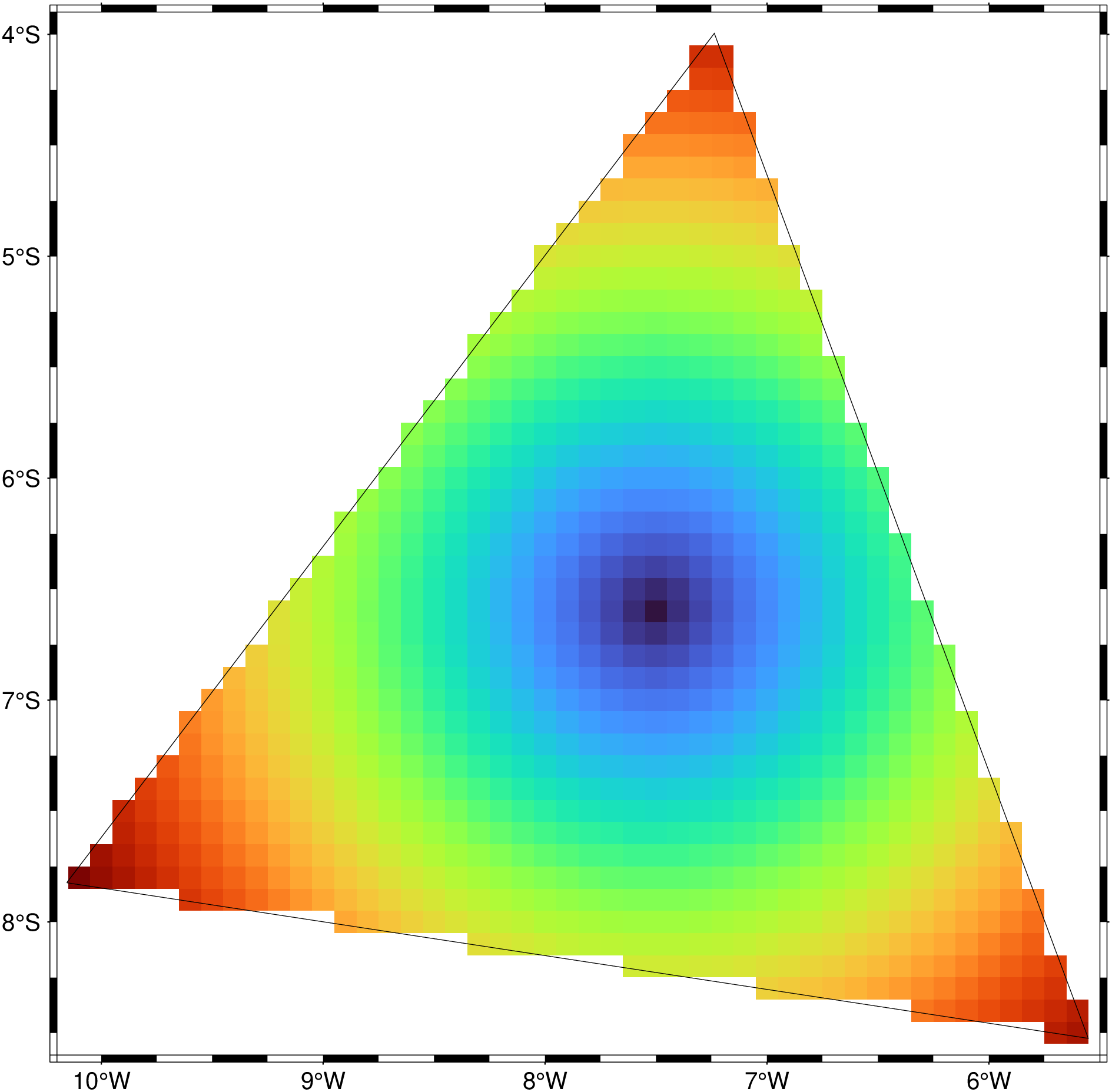
using GMT

G = grdmath("-R-5/5/-5/5 -I0.1 -fg X Y HYPOT");
tri = [-2.411 -1.629; -0.124 2.601; 2.201 -1.629; -2.410 -1.629];
Gr, tri_rot = grdrotater(G, rotation="-40.8/32.8/-12.9", rot_outline=true, rot_polygon=tri);
imshow(Gr, plot=(data=tri_rot,))

Methods

# 4 methods for generic function "grdrotater" from GMT:
 [1] grdrotater(cmd0::String; ...)
 [2] grdrotater(; ...)
 [3] grdrotater(cmd0::String, arg1; kwargs...)
 [4] grdrotater(arg1; kw...)

See Also